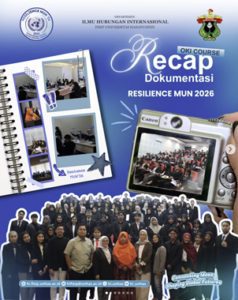
Makassar, June 23–24, 2026 — The Department of International Relations, Faculty of Social and Political Sciences, Universitas Hasanuddin, successfully held the Hasanuddin Dialogue on Global Affairs Simulation (HDGAS) 2026 under the theme “Navigating Diplomacy in a Volatile, Uncertain, Complex, and Ambiguous (VUCA) World.” The event was conducted as the final project and assessment for the course Theory and Practice of Diplomacy for Regular C and International Class students.
Held at Syukur Abdullah Hall, 3rd Floor, FISIP Unhas, the two-day simulation took place on June 23–24, 2026, with sessions running from 07.30–16.00 WITA on the first day and 07.15–09.40 WITA on the second day. The program adopted a high-level diplomatic panel format inspired by the Shangri-La Dialogue organized by the International Institute for Strategic Studies (IISS), aiming to simulate real-world multilateral diplomatic engagement.
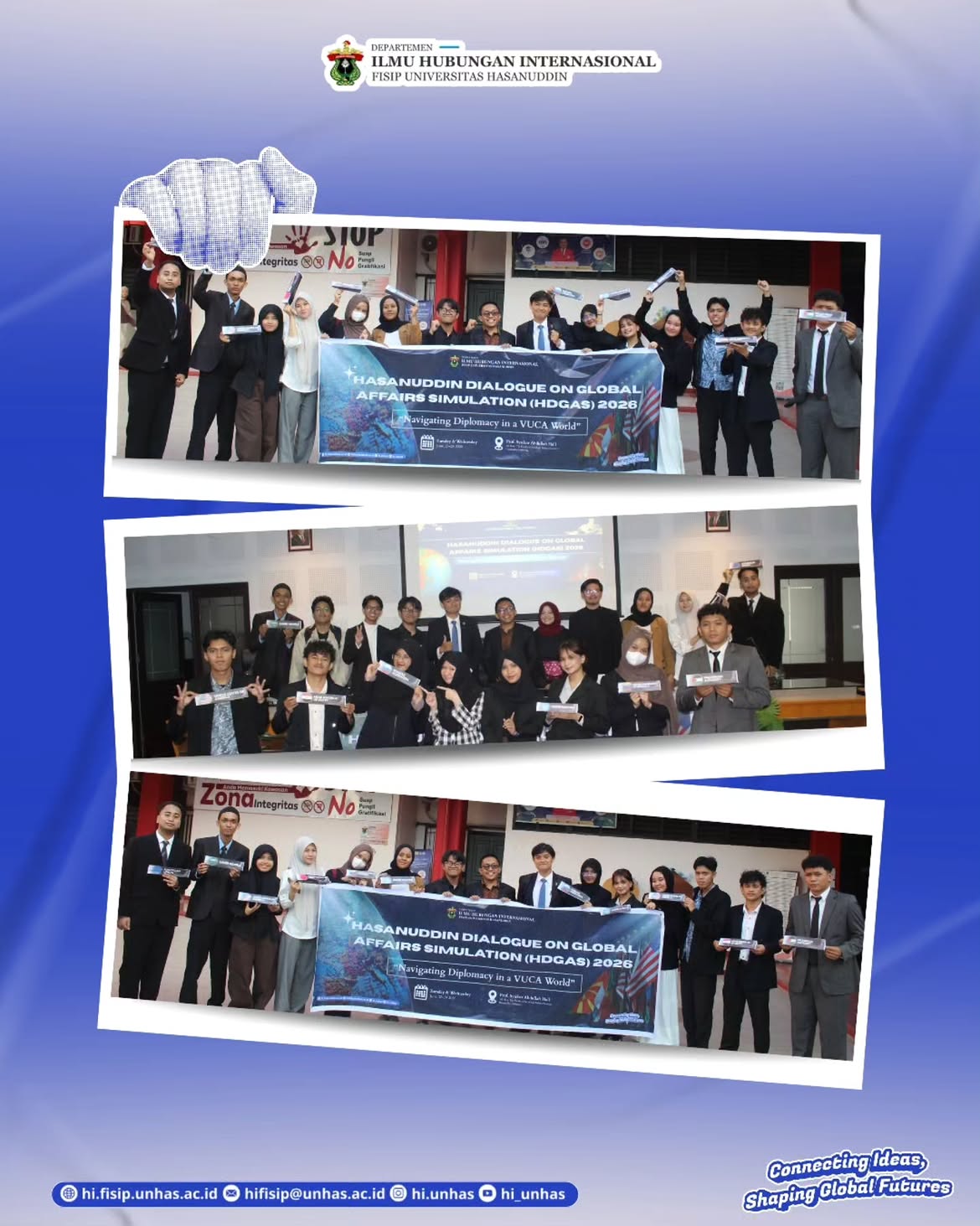
HDGAS 2026 was designed to train students in the practice of multilateral diplomacy, strengthen negotiation and public speaking skills, and enhance their ability to articulate the official positions of international actors on pressing global issues. Through structured panel discussions, participants were encouraged to analyze complex geopolitical dynamics and propose diplomatic pathways in addressing global instability.
The simulation featured four major panel sessions, each focusing on critical contemporary issues. The first panel, “Fire Across the Middle East: Diplomacy Amid the U.S.–Israel–Iran Confrontation,” examined escalating tensions driven by Iran’s nuclear program, regional proxy conflicts, and direct military exchanges involving Israel and Iran, alongside the strategic involvement of the United States.
The second panel addressed “The Gaza Conflict (2023–2026),” highlighting one of the most severe humanitarian crises in recent decades, marked by mass casualties, infrastructure collapse, regional instability, and stalled peace negotiations that have further complicated prospects for a two-state solution.
The third session, “Operation Resolve: The Capture of Nicolás Maduro and the Future of Sovereignty in International Politics,” explored the global diplomatic crisis triggered by the U.S. operation in Caracas, raising questions on sovereignty, head-of-state immunity, and the legitimacy of unilateral enforcement actions in international law.
The fourth panel, “Chokepoint Crisis – Diplomacy and Global Security After Iran Closes the Strait of Hormuz,” discussed the global consequences of disrupted maritime trade routes, energy security challenges, and the geopolitical implications of controlling one of the world’s most strategic waterways.
Additionally, the simulation expanded its scope to include discussions on “The Future of Global Finance: Navigating the Shift from Dollar Dominance,” focusing on dedollarization trends, the rise of alternative currencies, and the potential restructuring of global financial governance institutions such as the IMF and World Bank.
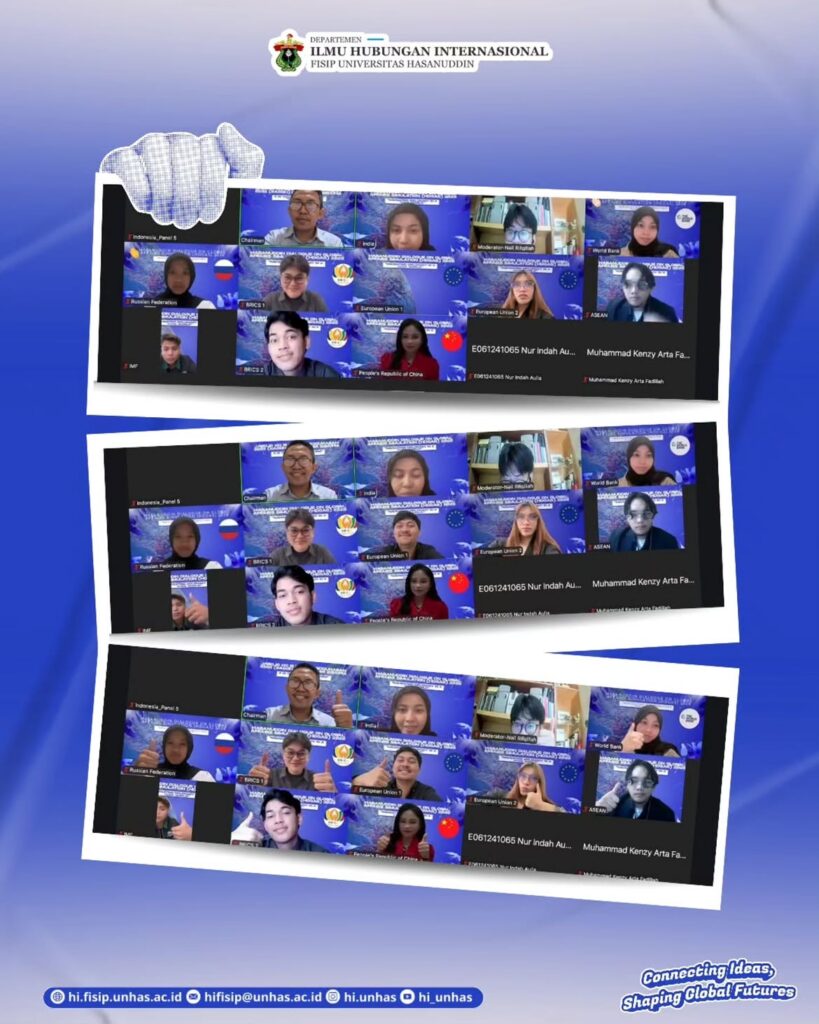
Since its inception, HDGAS has become an integral part of diplomatic education within the Department of International Relations at Universitas Hasanuddin. The 2026 edition further reinforced its role as a dynamic learning platform that bridges academic theory with real-world diplomatic practice.
Through this simulation, students were not only exposed to contemporary global challenges but also encouraged to think critically, negotiate strategically, and collaborate effectively skills essential for future actors in international diplomacy.
Writer: Rhin Khairina Rahmat, S.IP, M.AEditor: Munif Arif Ranti, S.IP, M.A