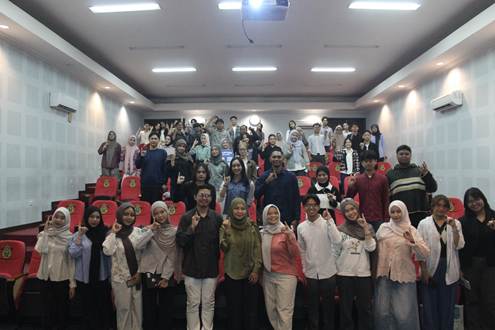
Makassar, June 17, 2026 — Students of the Department of International Relations, Faculty of Social and Political Sciences, Universitas Hasanuddin, successfully carried out the GEDSI Impact Initiative: Gender Equality, Disability, and Social Inclusion in Society at Prof. Syukur Abdullah Hall, FISIP Unhas, on Wednesday (June 17). The initiative was designed as the final project for the Gender Studies in International Relations course, emphasizing the importance of connecting academic understanding with real-world social engagement.
Rather than focusing on large-scale or purely theoretical outputs, this final project encouraged students to identify everyday issues related to Gender Equality, Disability, and Social Inclusion (GEDSI) within their communities. They were then challenged to develop simple yet practical initiatives aimed at raising public awareness. The primary focus was not on the scale of the project, but on its relevance, feasibility, and the ability to translate academic concepts into meaningful social action through creative, educational, and participatory approaches.
A total of 12 student groups participated, each presenting diverse and thought-provoking initiatives. These projects addressed a wide range of issues, from the often-overlooked burden placed on young girls as “second mothers” within families, to the normalization of verbal harassment against women in public spaces. Other groups highlighted the importance of inclusive education, the reintegration of formerly incarcerated women into society, and the need to challenge gender stereotypes in career choices.
Several initiatives also focused on contemporary social challenges, such as creating safer digital spaces, addressing online gender-based violence, and combating ableist jokes on social media through inclusive and human security-based campaigns. Meanwhile, topics like toxic masculinity on campus, community-level inclusion through participatory decision-making, and gender representation in industries such as perfume demonstrated the breadth and creativity of student perspectives.
The outputs of these initiatives were equally varied and innovative, including campaign and educational videos, interactive posters and infographics, digital pocket books, social media campaigns, and other creative media. These products were designed not only to inform but also to engage audiences in a more accessible and relatable way.
Through the GEDSI Impact Initiative, students were able to deepen their understanding of gender and inclusion issues while developing essential skills such as critical thinking, public communication, teamwork, and social sensitivity. More importantly, the initiative demonstrated that impactful change can begin with small, realistic actions when grounded in awareness and collective effort.
By bringing academic concepts into direct engagement with society, the GEDSI Impact Initiative 2026 reflects a growing commitment to making international relations studies more responsive to real-world challenges. It stands as a reminder that discussions on equality, inclusion, and human dignity are not confined to theory, but are lived realities that require continuous attention, empathy, and action.
Writer: Rhin Khairina Rahmat, S.IP, M.A
Editor: Munif Arif Ranti, S.IP, M.A