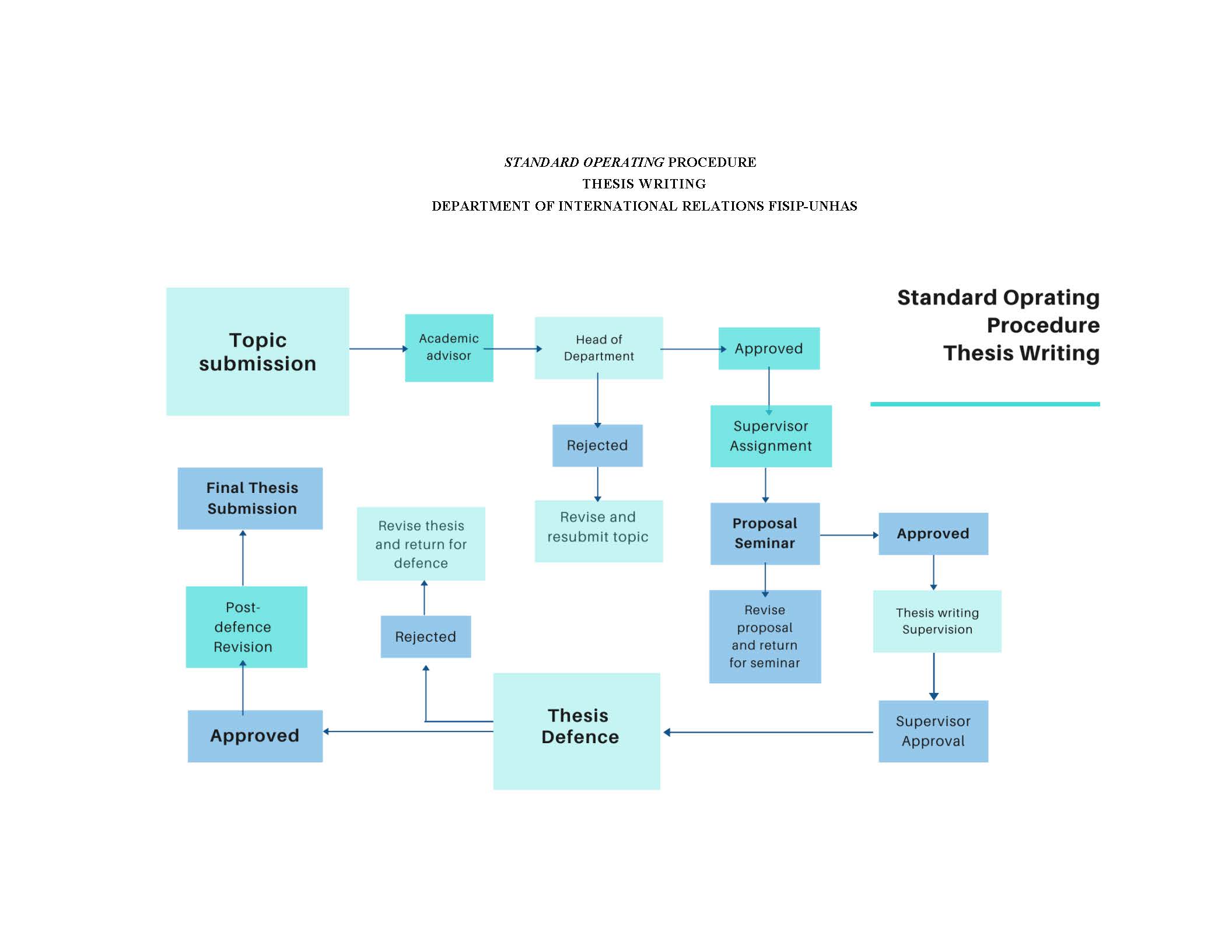
A. Thesis Structure
1. Preliminary Section: Title page, approval sheet, abstract (in Indonesian and English), preface, table of contents, list of tables/figures (if any).
2. Main Content :
Chapter I: Introduction (background, problem statement, objectives, benefits, conceptual framework, research methods)
Chapter II: Literature Review.
Chapter III: General Description.
Chapter IV: Results and Discussion.
Chapter V: Closing (conclusion, suggestions).
Supplement Section: Bibliography, appendices (if any).
3. Use Times New Roman font, size 12, 2 line spacing.
4. Margins: left 4 cm, right 3 cm, top 3 cm, bottom 3 cm.
5. References follow the latest APA (American Psychological Association) style.
6. Thesis length: minimum 80 pages and maximum 150 pages (excluding appendices), with 30% consisting of Chapter IV Results and Discussion.
B. Thesis Scopes
1. Thematic Scope :
The central theme of the thesis must address over-boundary activity of international relations actors (state/non-state). The topic may focus on the following issues:
– Foreign policy analysis.
– International conflict and peacebuilding.
– Diplomacy and negotiation.
– International organizations.
– Global governance.
– Security studies (traditional & non-traditional).
– International political economy.
– Migration and refugee issues.
– Human rights and humanitarian intervention.
– Environmental politics and climate diplomacy.
– Regional studies (e.g., ASEAN, EU, Indo-Pacific).
– Etc.
2. Geographic Scope :
The thesis topic must specify the geographical focus, such as:
– A specific country (e.g., Indonesia, United States).
– A bilateral relationship (e.g., China–US relations).
– A region (e.g., South China Sea, Middle East, Indo-Pacific).
– Global level, if the topic addresses transnational or systemic issues.
3. Temporal Scope :
The thesis topic must specify the time frame of the study:
– A historical period (e.g., Cold War era, post-9/11 period).
– A range of years (e.g., 2015–2024).
– A contemporary analysis of current events or ongoing developments.
4. Conceptual Scope :
The thesis analysis must use IR theoretical framework and conceptual tools, such as:
– Grand theories (Realism, liberalism, constructivism, marxism, etc).
– Concepts and theories (soft power, strategic culture, sovereignty, interdependence, etc).
5. Methodological Scope :
The thesis must use one of the following the research methods:
– Qualitative (e.g., case study, discourse analysis, interviews).
– Quantitative (e.g., statistical analysis, survey).
– Mixed methods.
And use primary/secondary sources, official documents, media analysis, etc.
6. Limitations :
It is important to clarify what are not covered in the thesis, for example:
– Unrelated theories, regions, time periods, or issues.
Specific data limitations, language barriers, or access issues.