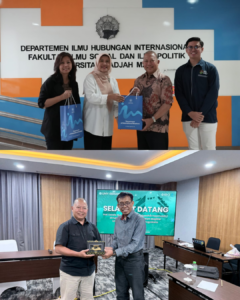
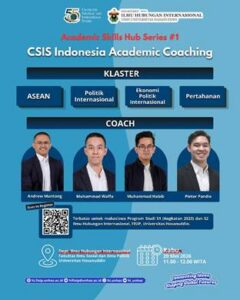
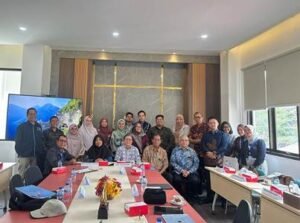
The Department of International Relations, Faculty of Social and Political Sciences, Universitas Hasanuddin (Unhas), convened a Focus Group Discussion (FGD) in collaboration with the Center for Strategic and International Studies (CSIS) on Wednesday, 20 May 2026.
The forum brought together at least 25 International Relations scholars and researchers from various universities, including Universitas Sulawesi Barat, UIN Alauddin, and Universitas Fajar. The participation of academics from Eastern Indonesia reflected an effort to incorporate diverse regional perspectives that have often been underrepresented in national-level foreign policy formulation.
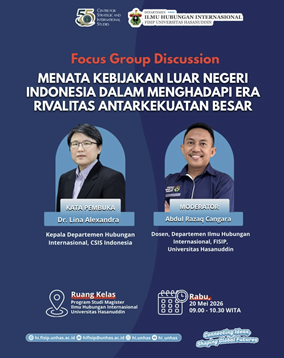
The primary objective of the FGD was to gather and synthesize academic insights regarding the recalibration of Indonesia’s foreign policy, particularly in relation to its long-standing free and active doctrine. This initiative is especially pertinent in light of increasingly complex global dynamics, which require foreign policy approaches that are adaptive, inclusive, and grounded in a balanced articulation of national interests.
As emphasized by Agussalim, a lecturer at Unhas, the government must accommodate aspirations from Eastern Indonesia to ensure that foreign policy formulation does not remain predominantly top-down or “inside-out” in nature. This statement underscores the importance of participatory mechanisms in shaping more representative and context-sensitive foreign policy strategies.
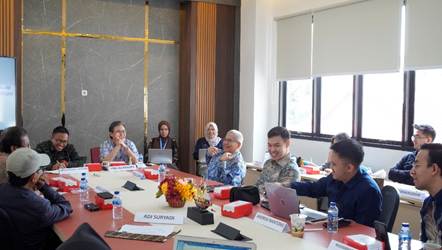
Subsequent discussions focused on identifying pathways for addressing strategic issues emerging from Eastern Indonesia. Key themes included maritime governance, population and migration dynamics, as well as ecological challenges. These issues are closely intertwined with Indonesia’s geopolitical positioning and the growing significance of non-traditional security concerns in the regional and global context. Participants highlighted the need for policy frameworks that are not only responsive to external pressures but also attentive to domestic regional realities.
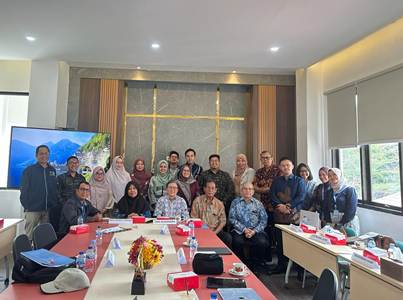
The FGD is expected to open new avenues for coordination among key stakeholders, particularly among local communities, academics, and government institutions. Moreover, it is envisioned as an initial step toward establishing sustained collaborative networks that can support the development of a more responsive, inclusive, and contextually grounded Indonesian foreign policy.
Writer: Rhin Khairina Rahmat, S.IP, M.A
Editor: Munif Arif Ranti, S.IP, M.A