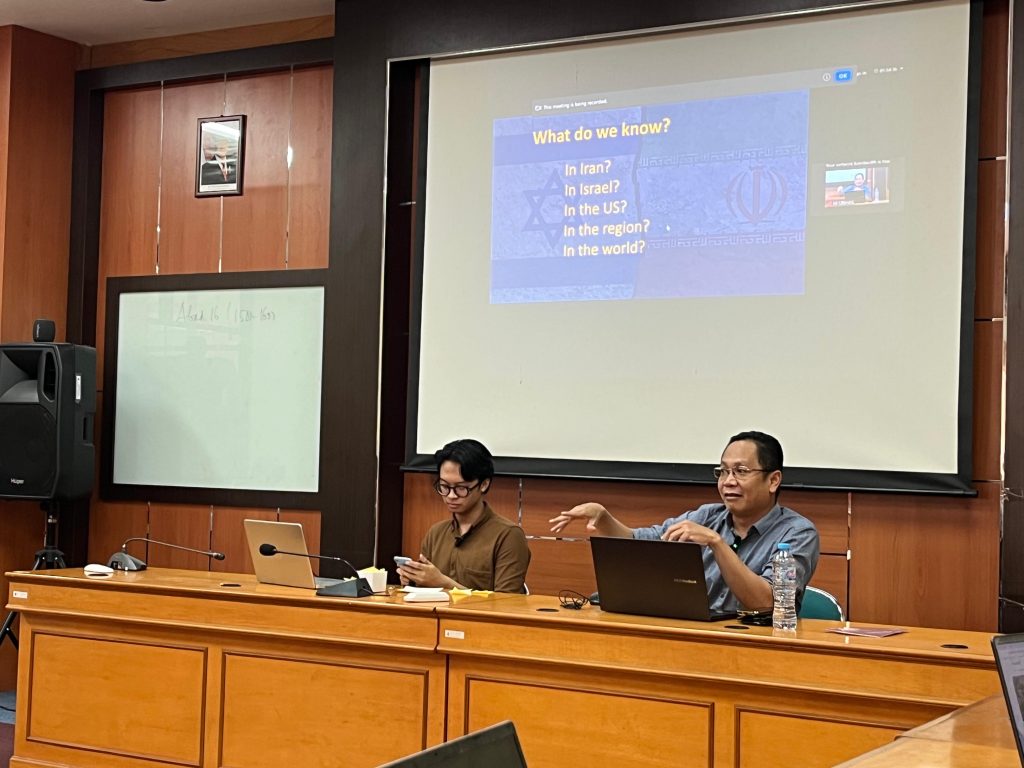
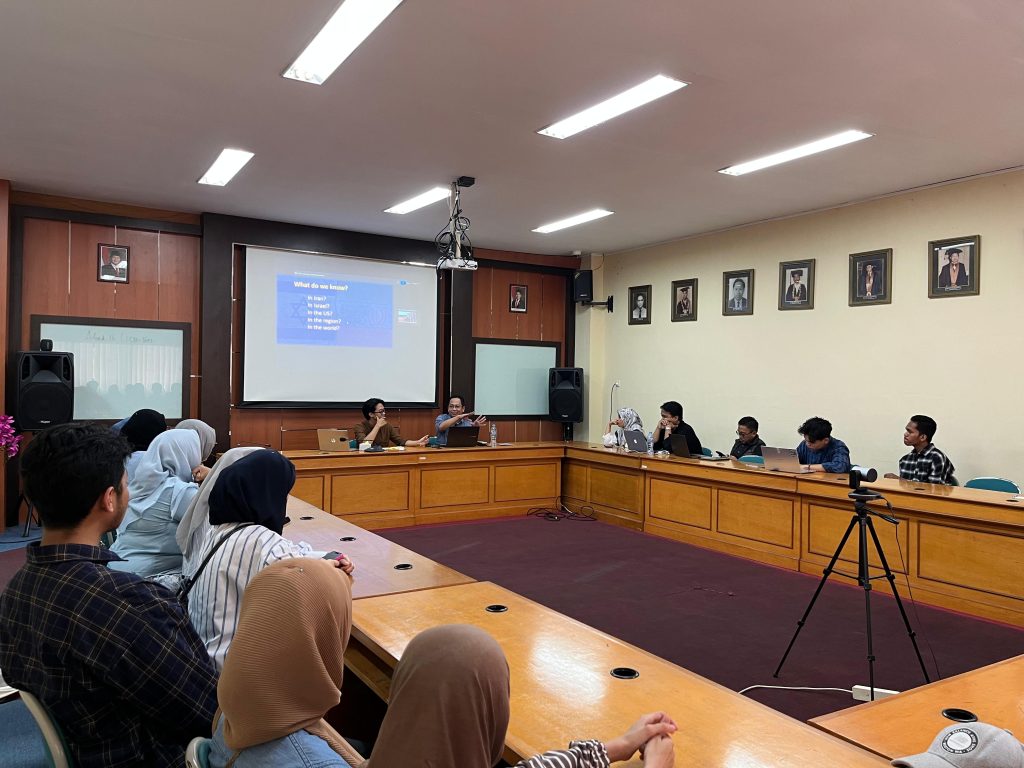
The Department of International Relations (IR) of Hasanuddin University once again held an interactive monthly activity, the Monthly Discussion. In this edition, the event presented Agussalim Burhanuddin, S.IP., MIRAP., Ph.D (Cand.), a lecturer at IR Unhas, as the main speaker. The discussion raised the theme “From Attack to Scale of War: Measuring the Capabilities and Potential Destruction of the Israel-Iran War” and was held on Tuesday, June 24, 2025, at 13.00-15.00 WITA at the Student Lounge, 3rd Floor, Department of IR Unhas.
In addition to being held offline, this event also provided an opportunity for online participation through the Zoom Meeting platform to reach a wider audience. One of the issues in the spotlight in the Israel-Iran conflict is the military attack carried out by Iran on Israeli territory, which is considered a violation of international law. This was caused by the loss of life among Iranian scientists who should have been protected as non-combatants under humanitarian law. The impact of this attack also created instability in Israeli society. Their reliance on a defense system that had previously been considered strong began to waver after experiencing an attack that caused significant damage. Fear of potential further attacks prompted some Israeli citizens to undertake a mass exodus to Cyprus and several regions in Europe, reflecting a crisis of confidence in the country’s security guarantees.
One important aspect of the Israel-Iran conflict that has attracted attention is the involvement of the United States, which also carried out attacks on Iran. However, this attack has raised constitutional debate because it was carried out without official approval from Congress, so it is considered a violation of US domestic law. In the discussion, Agussalim Burhanuddin emphasized that both the attacks launched by the United States and the retaliation from Iran were actually symbolic. This can be seen from several US attacks that were known in advance by Iran, so they could be anticipated before they had a significant impact. This phenomenon reflects that the military actions of the two countries are more of a political communication strategy and a show of strength, rather than a real effort to create a large-scale military escalation.’
Another important aspect of the Israel-Iran conflict is how the world’s major countries respond to the dynamics that occur. In the discussion that took place, it was revealed that Russia firmly opposed military action carried out by Israel and the United States. Meanwhile, China is in a dilemma where on the one hand, they want to assert their global influence by considering their support for Iran, but on the other hand they are very careful about the potential negative impacts, especially those related to their dependence on oil supplies. Therefore, China is currently still in the intensive observation stage, considering the most strategic steps so as not to harm their own national interests.
This calculating attitude reflects China’s diplomatic caution in facing complex and risk-laden geopolitical tensions. Furthermore, this discussion took place interactively through a question and answer session and the delivery of opinions, which not only involved students, but also lecturers from various backgrounds of thought. This active participation created a discussion space that was rich in perspectives, while deepening understanding of global conflict issues. Closing the discussion, Agussalim Burhanuddin emphasized that the possibility of a third world war is still relatively low. This can be seen from the pattern of attacks that have occurred so far, which are considered not to have shown serious intensity and escalation towards a global war.