Makassar, April 10, 2025 – The Department of International Relations, Hasanuddin University once again presents an inspiring academic activity through the holding of a guest lecture in the International Business course. This guest lecture presents an active diplomat from the Ministry of Foreign Affairs of the Republic of Indonesia, Ni Putu Widhia Setiani Asak, SH., LL.M who is also pursuing a doctoral study (PhD Candidate) at Amsterdam Law School, University of Amsterdam. This lecture was guided by Kak Biondi Sanda Sima (Lecturer in International Relations, Unhas) as the moderator who ensured the smooth running of the lecture session.
This guest lecture activity took place on Thursday, April 10, 2025, at 15.45–17.00 WITA, via the Zoom Meeting platform with the topic “The Interplay between Climate Change Regime and International Trade: A Perspective on Common but Differentiated Responsibilities and Respective Capabilities (CBDR-RC)”. Mrs. Widhia wants to introduce the CBDR-RC principle to the nation’s generation and has a mission to build a shared narrative on how we see CBDR-RC as an important element in negotiations on climate change.
The opening of the lecture began with remarks by the Head of the Department of International Relations, Hasanuddin University, Prof. Darwis, M.A, Ph.D. In his remarks, he emphasized that the topic of climate change is one of the interesting issues to discuss for third countries.
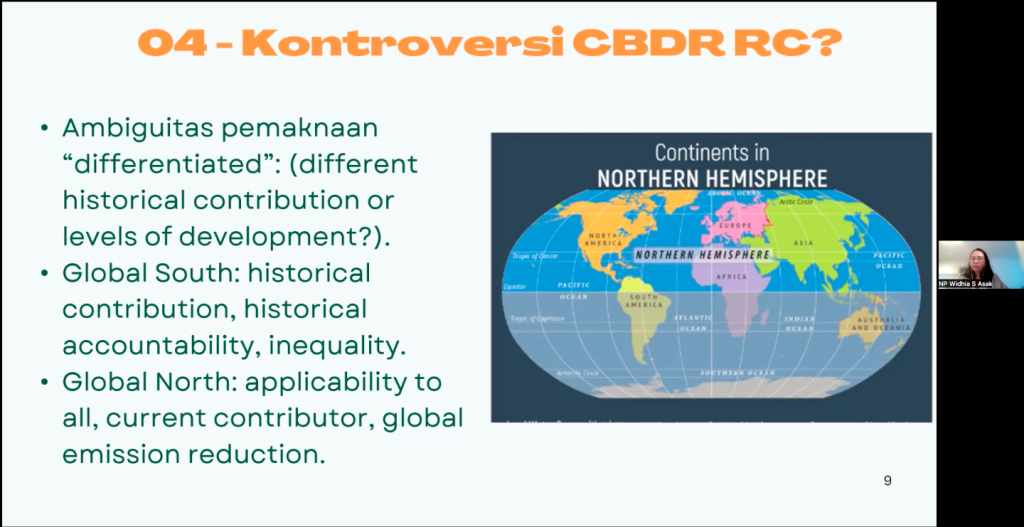
In her material, Mrs. Widhia explained that climate change is a global threat that requires immediate and strong collective action, because its impacts differ in each country. She emphasized the importance of international law such as the UNFCCC and the Paris Agreement which are binding on all countries. The principle of Common But Differentiated Responsibilities and Respective Capabilities (CBDR-RC) is the main basis for the climate change regime, applies to adaptation, mitigation, and climate-based trade policies, and strengthens the global narrative in various international forums and discussions. During the delivery of the material, several students also gave their opinions on the topics discussed.
“What unites the views of the developed countries with the developing countries is this principle. The CBDR-RC principle is very important and we can actually use it as a negotiation tool in various discussion forums,” said Mrs. Widhia in her material.
In addition to the presentation of the material, this lecture was also equipped with a question and answer session that provided an opportunity for participants to interact directly with the speakers. Through this session, students can ask questions related to the topics discussed, as well as delve deeper into the principle of Common But Differentiated Responsibilities and Respective Capabilities (CBDR-RC) in the context of the international climate change regime.
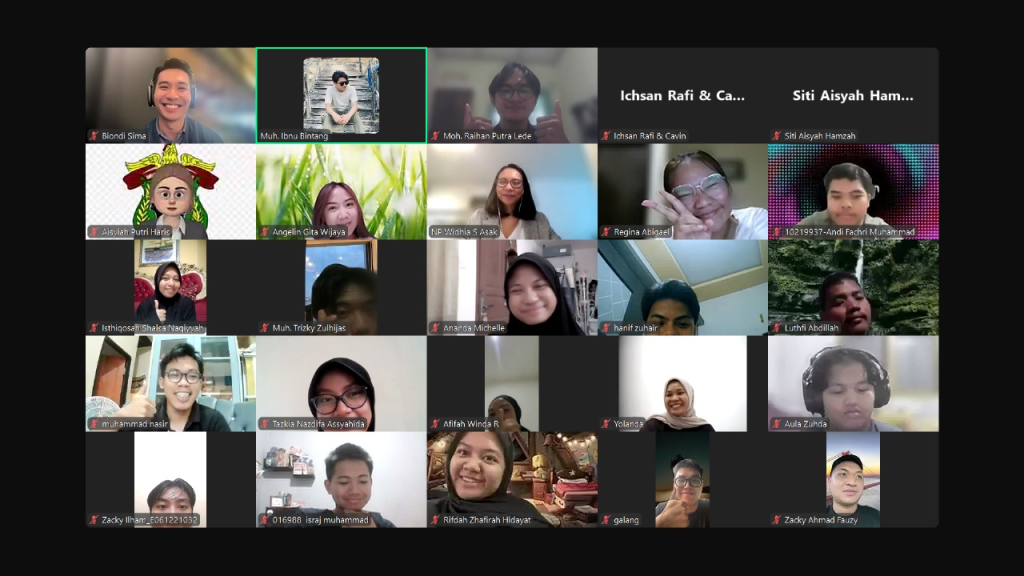
This guest lecture is a very informative session for International Relations students, because it provides an opportunity to delve deeper into the relationship between climate change and international trade, and find its relevance for developing countries such as Indonesia. This activity is expected to broaden students’ horizons in understanding interconnected global issues, as well as encourage the birth of critical and analytical thinking in responding to the challenges of the international world, especially in the fields of environmental diplomacy and the global economy.
For more information, visit the official HI UNHAS social media at:
Instagram: @hi_unhas
TikTok: @hi_unhas
Website: hi.fisip.unhas.ac.id